Showing posts with label vegetable: corn. Show all posts

Monday, June 30, 2008

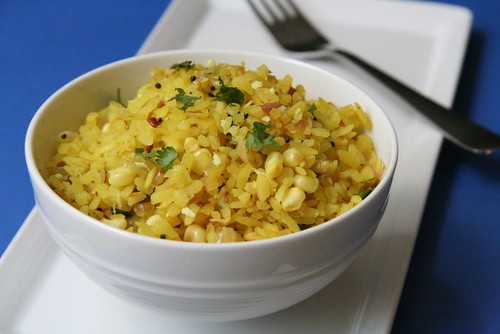
Pohe with Summer Corn

'Long time no pohe', was the refrain heard around here a few times. I knew it was true, and there was no excuse for it to be true either. Making pohe is simple, it tastes good, and it makes for a light and delicious breakfast or snack any time of the year, but not being too high in my list of favorites, it sometimes takes a backseat in the kitchen. I enjoy it every once in a while, and that is about it. While I am open minded (really!) about most things and don't mind trying all kinds of variations when I am cooking, I am rather finicky about the way I like my pohe. First of all, I like it to be well balanced in terms of the spice, tartness, saltiness and sweetness. The under-seasoned bland version isn't for me. For reasons unknown, I also don't like cumin seeds in pohe, and I much rather prefer red Indian chili powder to green chilies. What a whine, eh! I won't complain if someone made it some other way and gave it to me on a platter, but you get my point.

Growing up, pohe was a weekend ritual of sorts, and over the years, adding some kind of vegetable also became the norm. Usually peas, when they were in season, sometimes carrots or potatoes, but coming full circle, I now prefer pohe with onions, and without any other vegetables, which is called as 'kande pohe', in marathi, and only occasionally the potato version, or 'batate pohe'. Having said that, this time I added some succulent early summer corn, and it was great.

A combination that was possibly peculiar to our household was that of serving roasted papads alongside. Haven't heard of it? Outside of our family, neither have I, but there have been many converts to this combination, after having eaten it at our place. The papad of choice at home was usually poha papad (pohyAche pApaD), and the crispness of papads went perfectly well with the soft and chewy pohe. This is a tradition I have carried over, but have to make do with whatever papad is available on hand. Other things that were served alongside were grated coconut, chopped cilantro, and a small bowl of tamarind juice, for those who wanted to add some tartness to their pohe, and I suspect some of these too were somewhat non standard.

In Marathi, poha is singular, and would mean just one flake, and pohe is the plural, but I have always seen bags of it in Indian grocery stores labeled as 'poha'. So that is what you would look out for, in case you are unfamiliar with these rice flakes. For this particular recipe, I prefer to use 'extra thick' pohe, as sometimes even the ones labeled as 'thick' are not thick enough. 'Medium' or 'thin' pohe are not used here, they have other uses.

Kande Pohe with Corn

Serves 2-3 for a light breakfast

2 cups extra thick or thick pohe
1/2 of a medium onion
1 corn on the cob, optional
2 Tablespoons oil
1/2 teaspoon mustard seeds
big pinch of asafoetida
1/2 teaspoon turmeric
5-10 curry leaves
1 teaspoon red chili powder or cayenne
1 teaspoon sugar
1 teaspoon salt, or to taste
3-4 Tablespoons grated fresh coconut, plus more to serve
1/4th of a lemon or lime, or 2-3 Tablespoons tamarind juice plus more to serve
3-4 Tablespoons chopped cilantro

Place the pohe in a fine meshed sieve, and run it through tepid water until completely wet. Place it over a bowl, with a lid on so that it stays moist and plumps up, for 15 minutes to half an hour.

In the meanwhile, slice the onion thinly cross-wise, then chop it further to make small and thin slices. With a sharp knife, remove the corn kernels from the cob.

When ready to start cooking, loosen the flakes of pohe with fingers so that they are separate and there are no clumps.

Heat the oil in a large pan, and add the mustard seeds to it. When they start to pop, add the asafoetida, turmeric, curry leaves, onion and corn. Saute together for a few minutes until the onion has softened. Add the pohe, chili powder, salt, and sugar. Reduce the heat, and stir everything together until the pohe are coated with the spices. Add the coconut, place a lid on the pan, and turn the heat off. If using tamarind juice, add it at this point. Let it sit for a few minutes and steam the pohe with the residual heat, then add the lemon juice, and cilantro.

Serve with additional coconut, cilantro, lemon, tamarind juice, and roasted papads.
IMG_8289_ed

This is my much delayed entry to this month's special Click: Yellow for Bri. Hop over to read why it is special.

Tuesday, August 28, 2007

Corn two ways: roasted bhutta and with potato

As August draws close to an end, I am getting ready to bid adieu to my favorite of the month, the summer corn. When it comes to produce, many people like to think of tomatoes come summer, but for me, it is corn. Especially the freshest fresh corn that one finds in the farmers market. If I could write poems, I would have composed an ode to it by now, but clearly that hasn't happened yet. By the way, frozen or canned do not even come close, and do not enter my thoughts or my kitchen either.

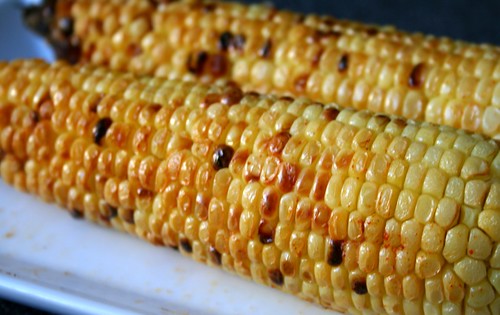
Bhutta: roasted corn

In India, corn or bhutta is usually eaten as a roadside snack, roasted over coal, and then sprinkled with lime and salt, sometimes with red chili powder or spices that would be the vendor's secret, and it is as blissful as it gets. Naturally that is my most favorite way to eat as well as cook corn. First, it needs to be roasted, grilled, or broiled to get evenly dark spots all around. In the meanwhile, in a small plate I take salt, red chili powder, some ghee, and wedges of lime. I dip a lime wedge into ghee, then into the salt and chili powder, and rub it all over the corn. Simple and elegant. Occasionally, I chhidkao (sprinkle) some chaat masala too.

In contrast in America, corn is usually a side as part of a meal or used as an ingredient. My introduction to it, of all places, was in the workplace cafeteria, where it was served alongside my entree. Boiled, and slathered with salted butter, it tasted like nothing I had eaten before. I was completely hooked. Corn here is indeed quite something - tender, succulent, sweet, delicious.

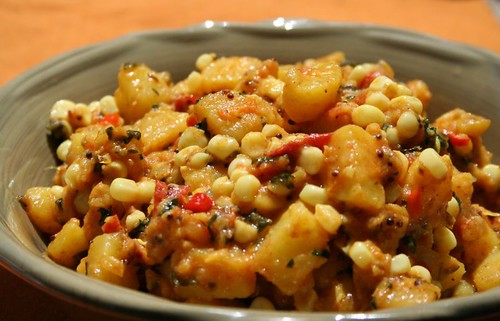
Usually every summer after I have had one corn on the cob too many, there are a couple of them in the fridge that need to be used up, and that is when I turn to one of my favorite dishes made with corn and potato. It is based on a recipe from the book 'Indian Cooking' written by Madhur Jaffrey and is called 'bhutta aur aloo ki mazedar tarkari', which roughly translates to 'a delicious corn and potato vegetable dish'. As with most of Jaffrey's recipes, I increase the amount of chili powder in it slightly. It can be served with rotis, or rice and dal, or eaten by itself.

Bhutta aur Aloo
Corn and Aloo Sabji

Serves 3-4

3 Tablespoons oil
1/2 teaspoon mustard seeds
1/2 teaspoon cumin seeds
1 clove of garlic, minced
1 medium potato, boiled and diced
1 medium tomato, chopped
4 Tablespoons chopped cilantro
3 Tablespoons chopped mint
1 green chili, chopped
2 cups of corn (roughly from two cobs)
about 1/2 cup coconut milk
salt to taste
3/4 teaspoon red chili powder
1 Tablespoon lime juice (about 1/2 a lime)
1/4 teaspoon ground black pepper
2 teaspoons ground roasted cumin

In a kadhai or wok, heat the oil and add the mustard seeds. When they start to pop, add the cumin seeds, followed by the garlic and potatoes. Stir fry till the potatoes start to turn golden brown. Add the tomato, cilantro, mint, and green chili. Stir around for a couple of minutes, and then add the corn and coconut milk. Stir it to make sure it doesn't stick to the pan. Lower the heat if needed and cook for a few minutes until the corn is cooked. Add the remaining ingredients one by one.

Notes

I don't always add the mint.

Sometime I substitute the coconut milk with whole milk or half and half.

Instead of using a regular potato, I sometimes use about four fingerling potatoes if I have them on hand, and it makes the dish even more wonderful.
Related Posts Plugin for WordPress, Blogger...