Showing posts with label dals. Show all posts

Monday, March 10, 2008

Five-Lentils Panchmel Dal

Casting a critical eye over my blog I find that it severely lacks one of the most basic everyday fare that I make on a regular basis regardless of season, and one that has endless combinations. I even knew the reason for that, and have known it for a long time now.

The food I am talking about is 'dal', and the reason is that dals have been the most challenging to photograph for me. No matter what I do, they all end up looking almost the same after they are cooked - just a big yellow something in a bowl, which makes it rather difficult to convey some of the amazing nuances of flavor that each dal has, despite all of them looking alike.
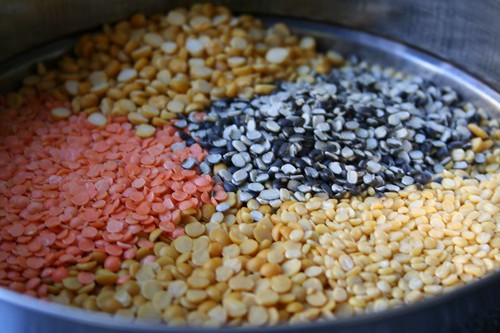
Panchmel Dal: the five dals
The beautiful colors of the five dals, very photogenic before cooking.

I am not a fan of styling food just for the purpose of taking photographs, even though I admire those who can do it well. I prefer to take pictures of food as it is meant to be served or eaten. The drawback is that this isn't the best way to showcase the food, and after all, exhibiting food in all its glory is one of the objectives of a food blog. One of the lessons here is that looks are not the best judge of taste.

Undaunted, I am going to post about dals anyway, because I know I have waited too long to post some things just because I did not have a good picture to accompany. They might all look similar, but each one will have a strong character, a distinctive taste, and a lot more than what meets the eye.

This particular dal is one of my favorites, and yet I make it only once in a while, when I want a change from the usual dals. Panch means five, and hence the name, which approximately means 'five together'. The added flavors to this dal are simple, but its unique taste comes from the combination of dals, which is different from either of them cooked individually. There is also a barely noticeable variation in textures of each dal, which is interesting. Along with a good drizzle of fresh ghee at the end, and white rice to accompany, this is excellent comfort food that doesn't need anything else alongside.
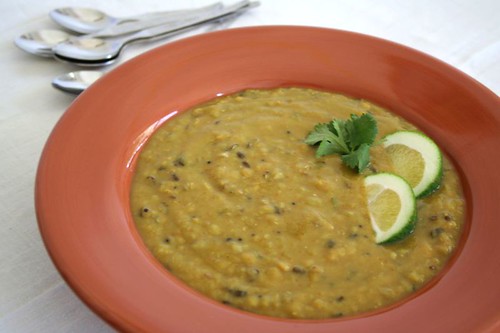
Panchmel Dal: 5 bean dal

Minor styling with wedges of lime, which are not usually tucked into the dal, but served alongside to be squeezed over the dal. The sprig of cilantro is chopped fine and scattered into the dal, optionally.

panchmeL DAL

Number of servings can vary a lot, from 4-8 depending on whether the dal is eaten as a main dish with rice or whether it is a part of a meal with other dishes.

Ingredients

1/4th cup each of toor dal, masoor dal, moong dal, chana dal, and split urad dal
1/4th teaspoon turmeric

2 Tablespoons oil
big pinch of mustard seeds
pinch of asafoetida
1/2 teaspoon turmeric
1/2 teaspoon cumin seeds
1 teaspoon chili powder (or to taste)
1 teaspoon cumin powder
1 teaspoon coriander powder
2 Tablespoons jaggery
2-4 tablespoons chopped cilantro
1/4th lime, plus extra wedges

Method

Rinse and drain the dals together a few times until the water runs clear. Cook all the dals together with 1/4th teaspoon turmeric in 5 cups of water. I use a pressure cooker with my usual 3-whistle regulation. Let the pressure drop.

Stir the dals together with a whisk, and add salt to taste. Add more water if needed to make sure it is of a pouring consistency.

Heat the oil a large and wide saucepan, and add the mustard seeds. When they start to pop, add the asafoetida, turmeric, cumin seeds and the rest of the spices. Stir quickly, add the dal, and bring it to a gentle boil. Stir in jaggery until it dissolves. Add chopped cilantro and squeeze the lime on top just before serving.

Variations

Some of the variations I have tried are adding curry leaves, or a little bit of finely chopped onion, and using tamarind or lemon instead of lime. Somehow, I like the tartness of lime better in this case.

Friday, February 01, 2008

Kancha Moong Dal with Meyer Lemon

In praise of 'Bengali Cooking: Seasons and Festivals'

A lot of cookbooks pass through my hands - at bookstores, in libraries, and through the virtual world of amazon's 'search inside' feature. While there are plenty of books I love, and even more that I want to buy, very rarely do I come across a book that makes me want to jump and evangelize! Chitrita Banerji's 'Bengali Cooking: Seasons and Festivals' did just that, very recently.

This is a fairly old book, first published in 1997, divided into four main sections called Basanta-Grishma (Spring and Summer), Barsha (Monsoon), Sharat-Hemanta (Early and Late Autumn), and Sheet (Winter), and each section delves into details about the food of that season, the whys and the hows of it, and how it relates to the produce, the beliefs, stories, fables, festivals, and so much more, that it is difficult to describe it in a few words. The book talks about the differences and contrasts in food between the various regions in Bengal, of Ghotis and Bangals, of Hindus and Muslims, of rich and poor, of the past and the present, along with plenty of recipes interspersed within the narrative. And yet, as it tries to cover so much ground it never feels as though it is meandering. The fact that Bengali cuisines is among those more unfamiliar to me says even more about the book. As Deborah Madison says in her foreword, this book reminds us that food is not separate from people, history, geography, and culture - in short, life itself. What I also love about the book is that it makes no concessions, and the author does not simplify the writing at any point for popularity's sake.

There are no photographs in the book, but the writing is so evocative that it paints enough pictures with words. Sometimes, the descriptions are so beautiful that I want to rush to the kitchen to rustle up some luchis with alur dom and chholar dal. What I do instead is run through page after page of the book, traipsing through West Bengal and Bangladesh, taking my time, dipping into the book every now and then.

If someone is looking for a book of Bengali recipes, then this is probably not the book for them. However, if you are not deterred by recipes that are not divided into neat sections of 'ingredients' and 'methods', and that do not necessarily give you exact amounts of everything, if you are intrepid enough about looking for a few unknown words, if you are not a new cook and do not need every step explained to you, if you are familiar with Indian food, and would like to know more about the context of Bengali food, you will love this book, regardless of whether you have eaten Bengali food before or not. This is evidently a book based on extensive research and personal experience.

The book has a glossary, but I was left fumbling with some names that weren't given in English. Knowing Hindi and Marathi, I could guess some of them, and with friends who know Bengali, translation help for the rest will be at hand if I need it.

So far, I haven't tried out a lot of things from the book, but like I said, the joy of this book is in the vivid descriptions, not necessarily in trying out recipes from it. The Kancha Moong Dal that I tried was simply stellar, with an amazing flavor using only a few ingredients that came together just right, and convinced me that the other recipes in the book would also be up to par, not that I ever doubted that anyway.

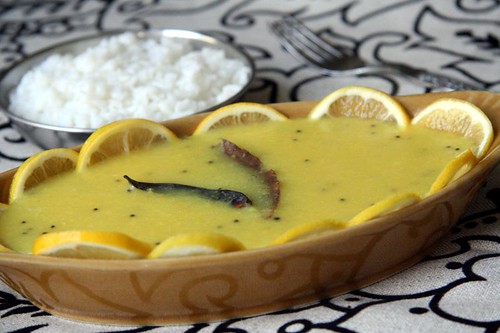
There is also a recipe in the book for a Bangladeshi Lemon dal, and I loved the way it described how thin slices of lemon are used to flavor the dal, so I used the leftover Kancha moong dal and turned it into Lemon dal, which was a wonderful way to use some of the Meyer Lemons from the yard, and the presentation looked beautiful.

The following introduction to the Kancha Moong Dal in an extract, and the recipe that follows is paraphrased, and uses the same style of recipe writing as used in the book.
In summer, the common dals in our house are moong and kalai rather than lentils, yellow split peas or pigeon peas. And while in winter the moong dal may be roasted in a frying pan before cooking, in summer it is preferred kancha or unroasted, because it is easier to digest and does not heat the system.

Kancha Moong Dal

Take 1 cup of moong dal and rinse the dal under running water for 3-4 miutes. Then it describes how to cook the dal in boiling water, but I cooked the dal with 4 cups of water and a pinch of turmeric in a pressure cooker.

Finely chop or grate a small piece of ginger, enough to make 2 teaspoons.

Heat about 1 tablespoon of oil, add 1 teaspoon whole mustard seeds, 2 dried red chilies, and when the mustard starts to pop, add the ginger, and 2 bay leaves. Stir for a minute, add a teaspoon of ghee, and pour the dal over it. Add a little sugar and salt to taste, and heat the dal through for a few minutes.

It then goes on to describe another type of phoron (tadka) that can be used instead of the above seasoning, and in a blink of an eye you have another recipe right there.

Lemon / Kancha Moong Dal

Lemon Dal

This is an extract from the book, keeping in mind the guidelines for fair use of copyrighted material, that illustrates how even a simple dal recipe sounds wonderful in the book.
Once, in Dhaka, a good friend of mine, Salma Sobhan, was talking to me about Muslim Bengali cooking. She explained that among its intricacies were a few simple dishes, like lemon dal, that amazed one with their taste. What was that, I asked, and she was taken aback at such ignorance.

For Lemon dal, it is the same kancha moong dal that is used. Once cooked with a little salt and water, it is sieved through a cheesecloth so that it comes out as a thick, creamy soup, without the fibres. Then a large porcelain or earthenware (never metal) serving bowl is taken and the bottom and sides lined with thin slices of lemon or lime. Bengalis prefer to use the fragrant kagaji or gondhi lemon, if they are available. Once the slices are in place, the sieved dal is put back on the stove, brought to a boil, and kept there for two or three minutes, then poured into the lemon-lined basin and kept covered for about five minutes to absorbe the taste and flavor of the lemon. This needs to be served with plain rice, preferably an atap (non-parboiled) rice like Basmati. The problem with this dal is that it can neither be reheated, nor kept overnight, for it tends to turn bitter.

Friday, December 07, 2007

'That' Methi Dal

Trying to recreate something from the past

It all started when a friend and I were talking and sharing our memories of hiking in the Sahyadris. Anyone who has ever hiked there knows of the joys - of walking through the hills in the rains, through the lush green grass, and the chipik chipik mud, of the smell of the pure air, the cool monsoon breezes, and of the rush of reaching the end of a trail or the top of a peak, or fort. Even though we did not know each other during our hiking days it turned out that we had been to many of the same trails and forts. So on we talked, of the people, the camaraderie, and of course the food, or lack thereof. I usually took food from home, as did most other people, and we usually shared it with our co-hikers, sometimes stopping whenever we were hungry, and sometimes waiting for everyone to get to the top to share our dabbas.

My friend spoke with great nostalgia about a spicy methi with dal and lots of green chilies that she had eaten with bhakris on one such trip. Even though it had been several years since then, she called it one of the best methichi bhaaji she had ever had. The person who had brought it happened to be a peon at her workplace, so there was not a chance of getting the recipe. It wasn't something I could relate to immediately, but started to have faint recollections of having eaten something similar somewhere too. Couldn't place it, and yet it seemed familiar.

Sometime after that conversation, I went to Bangalore during a visit to India, and friends of mine who live there took us out to eat a bhakri meal, or jolada roti as they called it, which is common in the northern parts of Karnataka close to the border with Maharashtra. The traditional meal came served on a banana leaf, and one of the things on it was what I thought could have been the dal-methi my friend had talked about! Here it is in the picture below, in the top right corner.

Northern Karnataka meal on banana leaf

After I came back here, I had more clues as to what to expect in terms of the taste, with the experience still fresh in my mind. I looked through some of my cookbooks to see if they had anything and Ruchira, the marathi cookbook had a recipe for something similar that used moong dal, but what I recalled was toor. So I decided to give it a try with toor dal and see if it tastes like it, and it pretty much did! I send the recipe to my friend to see what she thought, and when she gave it the thumbs up, I knew it was a success.

This dish is somewhere between a dal and a bhaji and is a very basic, rustic dish. It is neither runny nor dry and tastes great with bhakris. My guess is that it tastes best when made on a slow coal fire, and is probably cooked when methi is plentiful and in season, but cannot go far enough, which is why the dal is used to make it more substantial and economical.

Methi Dal

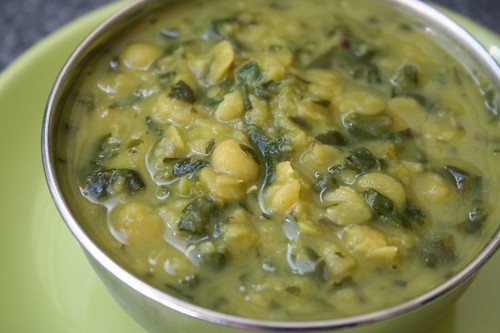
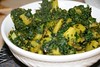
Methi and toor dal bhaaji

Serves 2 as a side, but can be scaled easily.

1/2 cup toor dal
1 big bunch of methi
2-4 green chilies (depending on size of chili and desired spiciness)
2 tablespoons of oil
salt to taste
pinch of sugar (optional)

Rinse the dal a few times and soak it in warm water for 5-6 hours.

Split the chilies into 2 along the length.

Just before cooking, drain the dal. In a large pan or wok, heat the oil, and add the chilies to it. Add the dal, stir it around in the oil, add 1 cup of water, and bring it to a boil. Place a lid on the pan and lower the heat. Let the dal cook until it is tender, adding more water as required. This could take somewhere between 30-40 minutes.

In the meanwhile, clean the methi, plucking the leaves and throwing away the stalks. Wash, spin, and chop the leaves fine.

When the dal is cooked, and has absorbed all the water, add the chopped methi, salt to taste, and sugar. Let it cook for another 10-15 minutes on moderate heat, without the lid.

Notes
The dal could be cooked in a pressure cooker too, but that would make it very soft like varan, which is not the desired consistency here.

One could also add mustard seeds and turmeric in the tadka, but I like the simplicity of the few strong ingredients.


Now 'this' humble methi dal goes to Linda, who is hosting Jihva: Toor Dal.

If any of you know what my friend could have been talking about, or have a different recipe for this, I would definitely love to hear about it.
Related Posts Plugin for WordPress, Blogger...